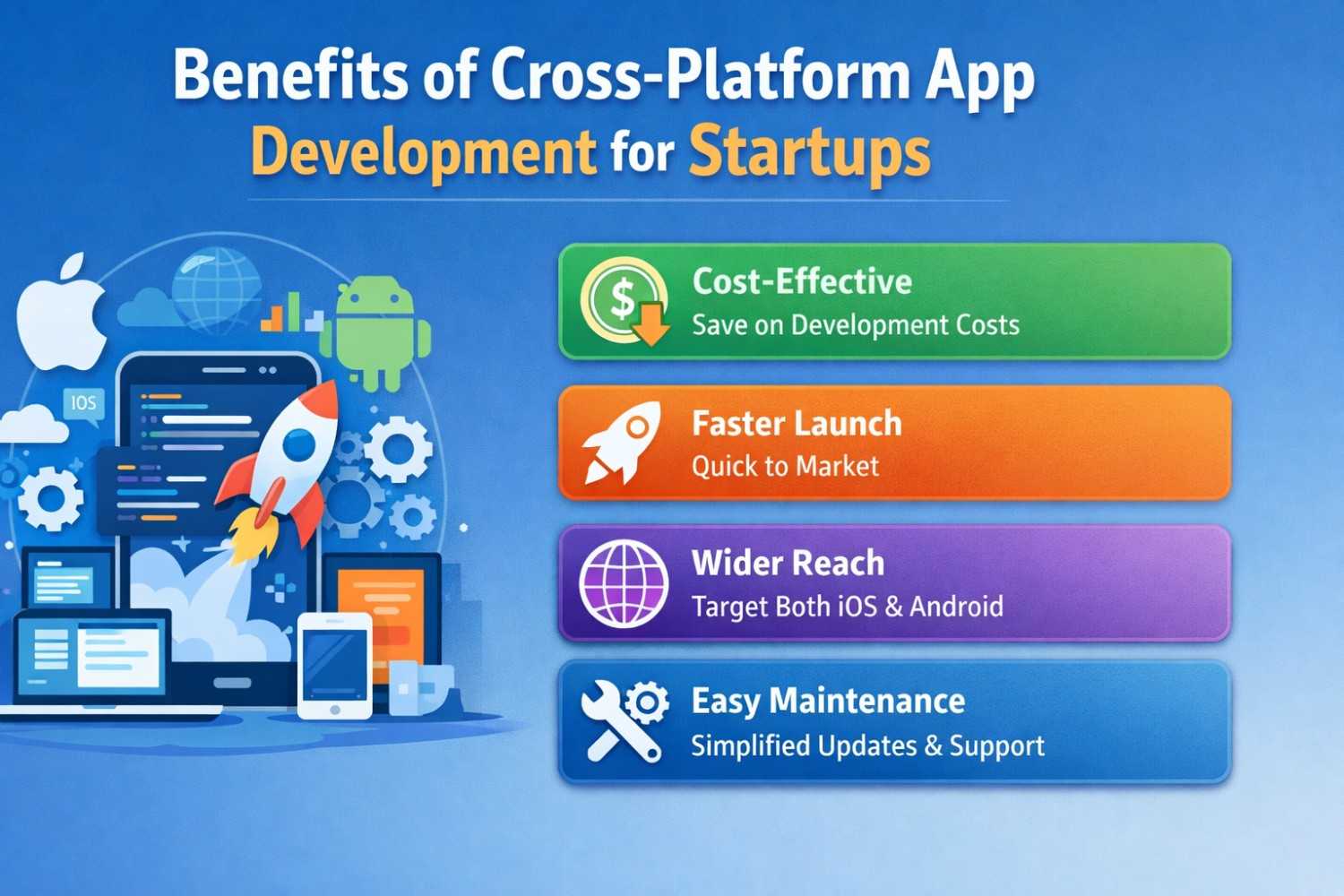
In today’s fast-moving digital ecosystem, startups face constant pressure to innovate quickly, manage limited budgets, and deliver seamless user experiences. Mobile applications often play a central role in achieving these goals, but developing separate apps for iOS and Android can be time-consuming and expensive. This is why cross-platform app development for startups has become an increasingly popular and strategic choice.
Cross-platform development allows startups to build a single mobile application that runs smoothly on multiple platforms. By reducing costs, speeding up development, and simplifying maintenance, this approach empowers startups to compete effectively with larger, well-funded enterprises. Let’s explore the key benefits of cross-platform app development and why it is ideally suited for startups.
Understanding Cross-Platform App Development
Cross-platform app development refers to the process of creating mobile applications using a shared codebase that works across different operating systems, primarily Android and iOS. Instead of developing two separate apps, startups can use frameworks that enable code reuse while still delivering near-native performance and functionality.
This approach aligns perfectly with the startup mindset—lean, efficient, and focused on rapid growth.
Why Cross-Platform App Development Is Ideal for Startups
Startups operate under unique constraints. Budgets are tight, development teams are small, and market validation needs to happen quickly. Cross-platform development addresses these challenges directly, making it an attractive option for early-stage and scaling startups alike.
1. Significant Cost Savings
One of the most compelling benefits of cross-platform app development for startups is cost efficiency. For startups operating on limited funding or bootstrapped budgets, these savings can be redirected toward marketing, customer acquisition, or product innovation.
How It Reduces Costs:
A single codebase eliminates the need for separate Android and iOS teams
Lower development hours compared to native apps
Reduced costs for testing, debugging, and maintenance
2. Faster Development and Quicker Launch
Speed is critical for startups looking to establish market presence and gain early traction. By reducing development timelines, startups can launch their products sooner, test their ideas in real markets, and make data-driven improvements without delays.
Cross-platform development enables:
Faster coding through reusable components
Simultaneous deployment on multiple platforms
Quicker iterations based on user feedback
3. Rapid MVP Development
Building a Minimum Viable Product (MVP) is a key milestone for startups. Startups can validate their ideas, attract early users, and pitch to investors without committing to expensive, full-scale native development.
Cross-platform development is especially effective for MVPs because it:
Minimizes initial investment
Accelerates product validation
Allows easy feature experimentation
4. Wider Audience Reach from Day One
Limiting an app to a single platform can significantly restrict market reach. This broader reach improves adoption rates and helps startups build a stronger user base from the start.
Cross-platform development allows startups to:
Launch on both Android and iOS simultaneously
Reach users across diverse demographics and devices
Increase brand exposure early in the product lifecycle
5. Simplified Maintenance and Updates
Maintaining two separate codebases can be complex and resource-intensive. This streamlined process is particularly valuable for startups that frequently iterate or pivot their product strategy.
With cross-platform development:
Bug fixes are applied once and reflected across platforms
Feature updates roll out faster
Maintenance becomes more predictable and manageable
6. Consistent User Experience Across Platforms
Consistency plays a crucial role in building brand trust and user loyalty. A consistent experience strengthens credibility and ensures that users enjoy the same quality regardless of the device they use.
Cross-platform frameworks enable startups to:
Deliver a uniform design and functionality
Maintain consistent branding across devices
Reduce user confusion caused by platform differences
7. Easier Scalability for Growing Startups
As startups grow, their apps must evolve to handle increasing users, features, and integrations. This future-ready approach ensures that startups don’t need to rebuild their applications as they scale.
Cross-platform app development supports scalability by:
Allowing easy integration with cloud services
Enabling modular feature additions
Supporting expansion to web or desktop platforms
8. Access to a Larger Talent Pool
Most cross-platform frameworks use widely adopted programming languages. For startups building lean teams, this flexibility simplifies resource planning and reduces hiring challenges.
This offers startups several advantages:
Easier hiring of skilled developers
Faster onboarding of development teams
Lower dependency on specialized platform-specific expertise
9. Strong Community and Ecosystem Support
Cross-platform frameworks are supported by active developer communities and rich ecosystems. Strong community backing reduces development risks and helps startups implement features efficiently without reinventing the wheel.
This benefits startups through:
Extensive documentation and tutorials
Ready-made plugins and libraries
Faster troubleshooting and support
10. Flexibility to Adapt and Pivot
Startups often need to pivot based on market feedback or changing business models. This adaptability is crucial for startups navigating uncertain and competitive markets.
Cross-platform development provides the flexibility to:
Modify features quickly
Test new ideas without heavy rework
Respond faster to user demands
11. Competitive Advantage in a Crowded Market
With reduced costs and faster launches, startups can focus more on innovation rather than technical limitations. This advantage can be decisive in crowded markets where speed and differentiation matter.
Cross-platform development allows startups to:
Allocate resources strategically
Compete with established players
Deliver high-quality apps without excessive spending
Is Cross-Platform App Development Always the Right Choice?
While cross-platform development offers numerous benefits, it may not suit every use case. For highly specialized apps requiring extreme performance or deep platform-specific functionality, native development may still be considered.
It is ideal when:
Budget and time constraints are significant
The app has standard features and workflows
Rapid scaling and iteration are priorities
Choosing the Right Development Partner
The success of cross-platform app development depends heavily on execution. Expert guidance helps startups avoid technical debt and build products that support long-term growth.
A reliable development partner can:
Recommend the right framework
Design scalable architecture
Ensure performance and security
Conclusion
Cross-platform app development for startups offers a practical, cost-effective, and scalable approach to building mobile applications in today’s competitive digital environment. By enabling faster launches, wider reach, simplified maintenance, and consistent user experiences, it empowers startups to focus on innovation and growth rather than technical constraints.
With the right strategy and expertise, startups can leverage cross-platform development to turn ideas into impactful digital products. Xoviontech works closely with startups to design and deliver high-quality cross-platform applications that align with business goals, accelerate market entry, and support long-term success.